Sunday, March 15, 2015

Did Harold die from an Arrow in the Eye?

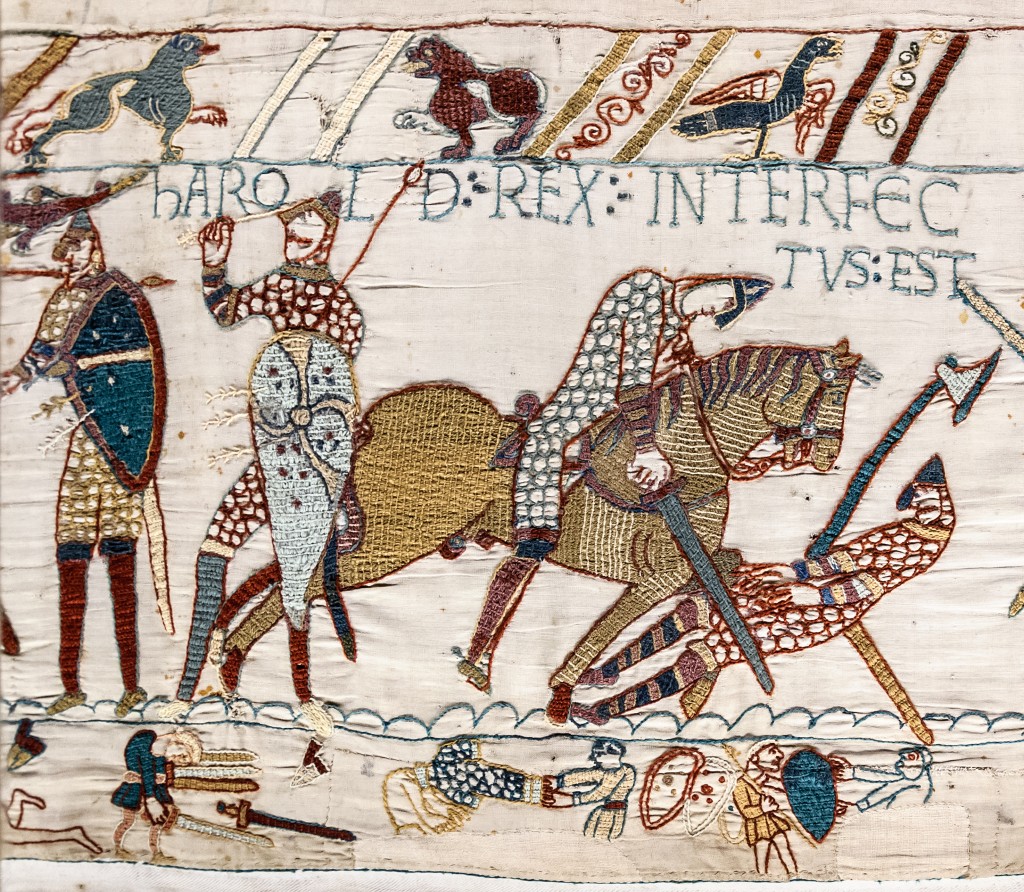
Tapisserie de Bayeux - Scène 57 : La mort d'HaroldThe Bayeux Tapestry gave us an iconic image of Harold pulling an arrow from his eye. It must be Harold: the name is embroidered around his head and spear. And since the Tapestry is created so close in time to the actual event, it is considered on of the major sources of documentation and hence to be trusted. But somehow, even the identification of the wounded hero is questioned by some, and further investigation raises more questions than it answers. Why?

Well, one thread of discussion is the identity of the figure at Harold's right, falling to the ground in the process of getting his leg cut off. As we learned from the 11th century Carmen de Hastingae Proelio, Harold was hacked up by four attackers (one of them might have been William). From 12th century Wace we learned that Harold was wounded in his eye by an arrow, then felled while still fighting, struck "on the thick of his thigh, down to the bone". So many historians think the second figure is Harold. A third opinion is that both figures are Harold, since the Tapestry could be read like a long cartoon, where one scene leads to the next.
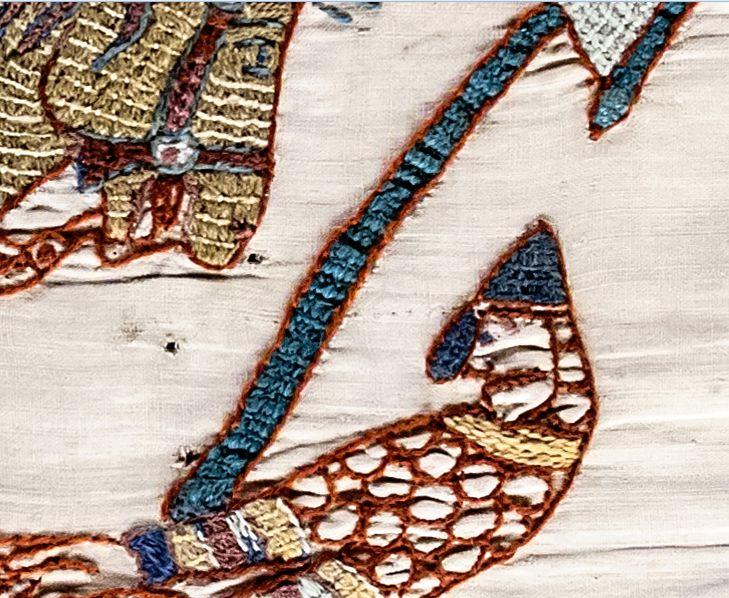
Harold ArrowholesI recently learned about evidence that gives credence to the third theory, but only a close-up view will enlighten: a row of holes next to the second figure's eye, that looks suspiciously like stitches that have been removed! An arrow? If so, then clearly this is the same figure as the other. As historian David Bernstein tells us in a thoroughly investigated "The Blinding of Harold and the Meaning of the Bayeux Tapestry", there are three possible explanations for this row of holes: 1. They are traces of original stitches, which must have indicated an arrow above his eye (not in it). 2. Traces of an arrow sewn in by a later "inspired" restorer, that were subsequently removed by that person or someone else, or 3. Traces of an unrelated repair. Bernstein pretty much discards the third possibility. But what of #2?
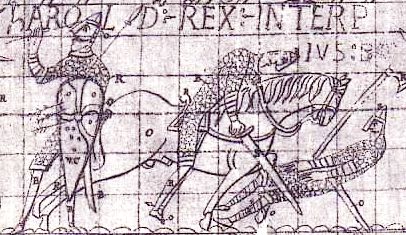
I should have realized that the Bayeux Tapestry was subjected to a few major restorations during its 900+ year-old existence. From what I can gather, it was restored in 1730, 1818, 1842 and most recently in 1982. It is recorded that the Victorian-era restorations are fairly easy to determine because the wool used for the embroidery left stains on the edges of the holes. But how many figures were altered considerably beyond their original form? And does Harold's death scene count among the alterations?
Sketches drawn by Antoine Benoît before the 18th century restoration do not indicate the row of holes next to the prone Harold's eye, so it is apparent they might have been added later.

Bernstein tantalizingly reassured us in his manuscript that the 1982 restoration was bound to enlighten us through scientific analysis, but so far I haven't been able to find the results of this event. Meanwhile, he gave us a theory as to why the Tapestry shows an arrow in the eye when not one of the six contemporary accounts mention it at all. He theorized that the arrow represented the hand of God in retribution for Harold's oath-breaking. After all, the Tapestry was a Norman creation (propaganda tool?) and it is possible that William saw this supernatural intervention as an expression of God's approval.

Friday, January 9, 2015

Why was King Edward called the Confessor?

Edward the Confessor is the only King of England to be canonized, though I think many would see him as an unlikely saint. Just for the record, up until the 4th century a Confessor was seen as a holy person who was tortured and suffered for his faith but not killed, as opposed to martyrs who were killed for their faith. After that, since persecutions had mostly ceased, a Confessor was a holy person who by virtue of his writings and preachings became an object of veneration. In reality, it seems that Edward’s canonization was more politically driven, as Osbert of Clare, the prior of Westminster Abbey started a campaign in the 12th century to increase the importance (and wealth) of the Abbey.  It took 20 some-odd years, a new Pope and a new King of England (Henry II) to finally canonize Edward in 1161. Ironically, his Feast Day is Oct. 13, the day before the Battle of Hastings anniversary (actually, it had nothing to do with Hastings. That was the day he was translated-moved to his new tomb-by St. Thomas of Canterbury in Henry II’s presence).

What made Edward so holy? Well, it is conjectured that his widow Editha commissioned the Life of King Edward (Vita Ædwardi Regis) partly to glorify the deeds of her family, partly to glorify her husband, and partly to excuse her lack of children. After all, if Edward was considered a holy man who was not interested in the things of this world, his sanctity would include refraining from the marriage bed; she couldn’t be held responsible for England’s fate. Nonetheless, this was our most important source for his life and cast him in a holy light. According to Catholic.org, “By 1138, he (Osbert) had converted the Vita Ædwardi…into a conventional saint’s life.”

Here is a legend I found on the Westminster Abbey website: “Edward was riding by a church in Essex and an old man asked for alms. As the king had no money to give he drew a large ring off his finger and gave this to the beggar. A few years later two pilgrims were traveling in the Holy Land and became stranded. They were helped by an old man and when he knew they came from England he told them he was St John the Evangelist and asked them to return the ring to Edward telling him that in six months he would join him in heaven.” When his uncorrupted body was translated in 1163 the ring was removed and placed with the Abbey relics, which of course were plundered in 1540 when the monastery was dissolved. Edward’s body was moved to some obscure place, but Mary Tudor had it returned in 1557 and replaced the stolen jewels with new ones.

Edward was considered one of the Patron Saints of England until Edward III created the Order of the Garter and promoted St. George in his place, although he has remained the patron saint of the English royal family. He is the first English King to cure people suffering from scrofula, “the king’s evil” by the touch of his hand; William of Malmesbury stated that he was already known for this in Normandy while an exile.  Interestingly, he is also the patron saint of difficult marriages and separated spouses.

Many would see his ungracious treatment of Earl Godwine in 1051, not to mention his insistence that Godwine wreak havoc with the unfortunate citizens of Dover, as unsaintly behavior. But in the end, his ardor in building Westminster Cathedral seems to have overcome any earlier indiscretions.

Thursday, July 31, 2014

Duncan was not killed in his bed by Macbeth

Shakespeare told some great stories, but historians will agree that real history often gets buried beneath the great Bard’s verses.  The death of King Duncan was one of those exaggerations.  For anybody who hasn’t read or seen Macbeth, in essence he meets three witches on the heath who plant the suggestion in his mind that he will be king.  The best way to achieve this is to treacherously kill King Duncan in his bed (as Lady Macbeth goads him on), put the blame elsewhere and seize the throne.  Righteous countrymen attack his castle in the end and restore the throne to Duncan’s heir.

Just for the record, when king Malcolm II died in 1034 at age 80, there were many claimants to the throne.  Duncan’s claim was from Malcolm II through his mother’s side (the first of three daughters).  Thorfinn of Orkney,  the great Viking warrior, was Malcolm’s grandson through the third daughter, and was raised under the protection of the King.  Malcolm  eventually made him Earl of Caithness (the first time the title of Earl was used in Scotland); this could have been a consolation prize.  Macbeth had a claim to the throne through his wife Grouch, who was considered the real heir based on the customary Tanist succession practiced in Scotland; her father’s claim had been put aside by Malcolm II in favor of Duncan.

So  Malcolm II had cleared the way for his favorite grandson, although the 33 year-old Duncan did little to recommend himself to his contemporaries.  He fought five wars in five years and lost them all.  Ultimately, he made the mistake of trying to claim Caithness which was rightfully ruled by his cousin Thorfinn.  This led to a sea battle where Duncan’s forces were ignominiously thrashed, and the king was forced to flee.

That same year in August, Duncan raised an army including many Irish mercenaries, and met either Thorfinn or Macbeth (or both) in the Battle of Burghead on the Moray Firth.  This could be same battle I found reference to stating that Macbeth killed Duncan at Pitgaveny, which was nearby.  It was also recorded elsewhere that Duncan was killed by his own men immediately after the battle.  Regardless of who actually killed him, it is clear that Duncan met his end on the battlefield rather than treacherously in bed.  Macbeth was properly elected high king by a council of Scottish leaders, apparently without dissent.   In fact, Macbeth ruled for 14 years.  This is a far cry from the grasping, tortured protagonist of Shakespeare’s dark tragedy.

Wednesday, July 2, 2014

Death of Alfred Aetheling

When Queen Emma (widow of Aethelred the Unready) married Canute around 1017, they agreed that the sons from their own marriage would take precedence over any previous children.  Things didn’t entirely work out that way, but for the duration of Canute’s reign, her first two sons, Edward and Alfred, remained exiles in her native Normandy.

The second son Alfred’s story is a pitiful one, though it has come down to us full of contradictions.  The part we are certain of tells us that during the reign of Harold Harefoot, while Emma lived at Winchester, Alfred landed on the Kentish coast with a band of followers.  On orders of the King he was seized, his followers either killed or sold into slavery, and Alfred had his eyes put out, soon dying of his wounds.  What we don’t know was why he came to England in the first place, and who exactly was responsible for the dastardly deed, looked upon by disgust even by the Anglo-Saxons hardened to such violence.

One of the rumors was that Emma, discouraged by the non-appearance of Harthacnut, sent a letter to Edward and Alfred encouraging them to invade England and claim the crown. Others conjectured they were testing invasion plans on their own volition. Some say King Harold forged a letter in their mother’s name, intending to lure them to their deaths. Still others said that her sons were simply paying her a visit.

It was said that Edward landed with 40 ships at Southampton and Alfred landed at Dover; the Norman account numbered Alfred’s followers at 600, though other accounts said he came with less than a dozen friends. It has even been stated that Edward fought a battle and defeated the English with great slaughter (considering Edward’s later peaceable reign, I tend to doubt this).  However, on hearing of Alfred’s fate, Edward made a hasty retreat back to the safety of Normandy.

It seems relatively certain that Alfred’s capture came as a surprise, and Earl Godwine of Wessex has invariably been linked with his arrest. It is alleged that Godwine wined and dined Alfred, lodged his men throughout the town, then in the middle of the night, either Godwine’s men or Harold’s men raided the town, capturing, torturing and killing the Aetheling’s companions. Whether Godwine followed direct orders from King Harold or whether he acted on his own recognizance is total conjecture. Or he simply might have stepped aside and refrained from interfering with the King’s business.

Did Godwine turn the Aetheling over to Harold’s soldiers, or was he personally responsible for taking Alfred to the island of Ely and blinding him?  Nobody really knows, but Godwine was blamed by many of  his contemporaries; even though he later cleared himself in court, he was never able to rid himself of the stigma attached to the murder. In any event, the brutal circumstances gave Godwine’s enemies a great deal of ammunition to fling at him.  Even at the end of his life, the legend persists that during a feast, Godwine made an oath to Edward that he should choke on a piece of bread if he was responsible for Alfred’s death. Then suddenly, the great Earl was taken with a siezure and collapsed at the table, thus confirming his guilt for all eternity.

Wednesday, May 28, 2014

The English Earldoms of 1045

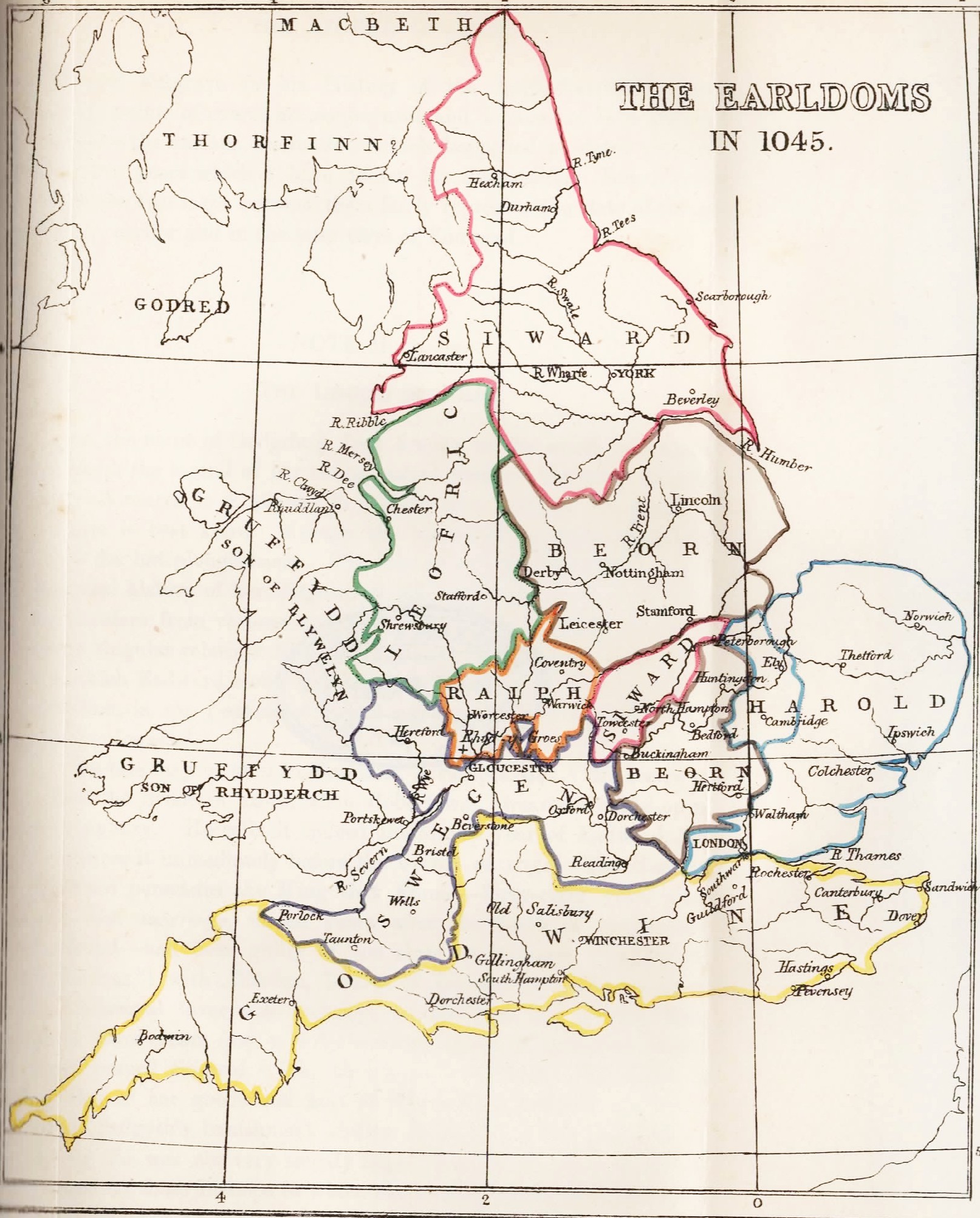
This map was scanned from Edward A. Freeman’s History of the Norman Conquest of England.  I found it in the Appendix of Volume 2 and I thought it was very helpful since a picture is worth a thousand words, as they say… doubly so for maps! 


I  hope you can read this map through all the rivers and towns (click on it to make the map a little wider); if you would like to see a larger version, drop me a line and I’ll send it to you.  These are the earldoms at the height of Edward the Confessor’s reign; the shifting of borders and earldoms was quite fluid during Edward’s reign, and this is a snapshot of the situation right before Swegn’s first exile.

These earldoms can be traced back to the great division during Canute’s reign, when he partitioned the kingdom into four great earldoms.  Wessex, the most important, was originally retained by the King then given over to Godwine in 1020. Mercia was given to Eadric (which only lasted until 1017), passed to Leofwine then to Leofric. East Anglia was given to Thurkill (banished in 1021) and eventually passed on to Harold Godwineson. The last, Northumbria, was given to Eric and eventually passed on to Siward the Strong.

Originally, Mercia stretched from east to west across the whole country from Bristol to Barton on the Humber.  As time progressed and the great earldom was dismembered, as Mr. Freeman suggests, it is unclear whether the smaller partitions were totally independent earldoms or whether they were subordinate to the Earl of Mercia.

Apparently both Harold and Beorn were given their earldoms in 1045. Beorn was the son of Ulf and Estrith, sister of Canute who was later married to Robert of Normandy.  Was this the connection that inspired Edward to make him an earl?  I found it interesting to see how Siward’s earldom was broken up by Beorn’s and how Beorn’s earldom was broken up by Siward’s.  Poor Beorn was the same who was murdered by Swegn Godwineson, but that was a few years later.

You can see Ralph’s earldom next to Swegn’s; this is the same Ralph of Mantes who was nephew of King Edward. When Swegn was exiled in 1046, Ralph’s earldom was expanded to encompass Hereford, where he was resoundly trounced by Gruffydd ap Llewelyn and the errant Aelfgar (son of Earl Leofric) in 1055.  Ralph died two years later.

During the reign of Edward, it’s not much of an exaggeration to say that the “big three” – Godwine, Leofric, and Siward held most of the influence with (or against) the king, depending on the situation. It’s interesting to see how Edward played one off against the other.

Wednesday, May 21, 2014

Alain le Roux, Count of Brittany (Earl of Richmond)

     Alain le Roux (c. 1040–1094) is one of my favorite historical characters who seems to have been relatively important in his time, but nobody seems to have heard of him.  Why do I like him so much?  Well, as I see it he went with  the flow (so to speak), amassed an incredible fortune (according to Wikipedia, at the time of his death he was worth around $166.9 billion, the equivalent of 7% of England’s national income.  Forbes placed him 9th in the list of most wealthy historical figures) and modestly did his thing, managing to keep King William happy as well as historians.
     Alain – called le Roux because of his red beard – hits  the historical stage around the time of the Norman Conquest.  He was in charge of the Breton contingent, a sizeable part of William’s invasion force.  If you recall, the Breton wing of the Norman army at the Battle of Hastings nearly lost the day: they were the first to panic and flee from the ferocity of the Saxons.  For a moment all was in chaos, then many of the inexperienced Saxon fyrd broke the shield wall and pursued the Bretons.  However, William rallied his men and cut off the Saxons from the rest of the army, wiping them out to a man.  Seeing the success of the maneuver, William instructed the Bretons to do it a couple of times more throughout the battle, with great success.
     After William become king he rewarded his supporters with grants of land and titles.  Alain was created the first Earl of Richmond, and a Norman keep stands on the site of his original castle overlooking the River Swale. In 1069, during the great Harrying of the North after the insurrection of Durham, Alain was the man William appointed to do the job.  By the end of his career, he had amassed over 250,000 acres in land grants.  Yet he is said to have died childless and his estate was inherited by his brother Alain le Noir (so- called because of his black beard).
     Early in my research for my upcoming novel,  “Heir to a Prophecy” I unearthed a story that my protagonist Walter actually went to Brittany and married Alain’s daughter, later taking her to Scotland and the court of Malcolm III where he was a favorite.  Although this is probably apocryphal, I did recently find an anecdote that makes me wonder if it could be true.
     Just the other day I was reading the book “The House of Godwine: The History of a Dynasty” (by Emma Mason) which was written 5 years ago.  Four pages from the end, the author states that King Malcolm planned to marry his daughter Edith to Count Alan the Red in 1093 (she was in the Wilton nunnery at the time), and King William Rufus forbid the union, causing Malcolm to storm out of the royal court. Now, why would Malcolm care about Alain unless there was some sort of connection between them (Walter)?
     Even more interesting (to me, that is), instead of Malcolm’s daughter, Alain actually took a fancy to another important novice at Wilton: Gunhild, daughter of Harold Godwineson and Edith Swanneck.  At the same time Malcolm took his daughter out of Wilton, Alain removed Gunhild (by then well into her 30s) and brought her to live with him…on the very estates he had taken over from her wealthy mother after Hastings.  When Alain died around 1094, Gunhild stayed and became the partner of Alain’s brother Le Noir, who succeeded to the estates.  What did she have to lose, after all?

Monday, May 19, 2014

Macbeth & Thorfinn of Orkney

The relationship between Macbeth and Thorfinn Sigurdsson, Earl of Orkney is more than accidental.  Thorfinn - known to  historians as The Black - was grandson of King Malcolm II and may have been raised in Malcolm's household.  However, he quickly became enemies with Malcolm's heir Duncan I, who tried to claim the earldom of Caithness on his accession to the throne.  Thorfinn bitterly contested Duncan's claims, and met him in battle at least twice, defeating the King's forces both times.


Macbeth had a claim to the throne through his wife Grouch, and it is thought that Thorfinn and Macbeth became allies against Duncan.  Shortly after the King's second defeat at Torfness, it is written that Duncan met Macbeth in battle at Pitgaveny on Aug. 15, 1040 and was killed on the battlefield.   This is a far cry from being murdered in his bed!


It is possible that after Duncan's death, Thorfinn and Macbeth managed Scotland jointly, for it is said that at the height of his power, Thorfinn ruled 9 northern earldoms.  Historians have written that Macbeth and Thorfinn went to Rome on Pilgrimage together.  Some actually believe they were the same person, although I think this is a stretch.  Nonetheless, you can read a lively story to this effect in Dorothy Dunnett's King Hereafter.


It's possible that Earl Thorfinn Raven-feeder  came to Macbeth's aid during the battle of Dunsinane.  He is said to have sailed up the Tay in support of Macbeth, and probably aided the King's escape from the battle, leaving Malcolm III victor on the field.  I write about this at length in my upcoming book, Heir to a Prophecy.